|
In his 1948 monograph A Study of the Glacial Kame Culture in Michigan, Ohio, and Indiana, Wilbur Cunningham accidentally set up a honey trap for future giantologists when he described some skeletal remains excavated in Branch County, Michigan, in 1906 (page 4): “Mr. Burch insisted that at least one of the adult skeletons was equipped with two rows of teeth!” A fantastic claim! Cunningham (1948:3) also notes that "The physician who measured the bones is said to have made the statement that two of the skeletons were of unusually large persons." There's not much discussion of the Branch County giants on the internet, which is understandable since there's not much to go on. One of the few posts referencing the remains, titled “Large Skull Branch County, Michigan,” but the URL refers to Indiana and they cite a book focusing on the Ohio Valley. It’s nothing more than a short re-hashing of Wilbur Cunningham’s (1948) research on the 1906 incident with a few vaguely related pictures, none pertaining to the incident itself. This post presents information from a "new" source (a 1906 local newspaper article) and compares it to Cunningham’s (1948) report. The year 1906 falls towards the end of a giant craze within the United States and yet there seems to still be quite a few discoveries from this period. In Omaha, for example, they discovered a skull that a Professor Henry Osborn of Columbian University believed to predate the Lansing skull, meaning that the Omaha skull would have been over 150,000 years old. In the same year as these discoveries, Clark L. Burch discovered multiple skeletons in a mound on his property, some of which were declared to be the remains of giants (or at least very large men). The Burch Farm was situated between the town line for the Coldwater and Batavia townships in southern Michigan. The mound in which Clark Burch located the remains (either two or five sets, depending on which source you follow), was regularly used by several local residents as a source of sand or gravel. A November 14, 1906 article in The Courier Newspaper (Coldwater, Michigan) described the discovery of the skeletons. Burch mentioned that this incident in 1906 wasn’t the first time that they had removed skeletons from the mound on his property. Roughly three decades prior, the brother of Ezra Shoecraft stumbled upon several skeletons that Burch described as gigantic. (I haven’t had any success with finding any mention of these skeletons outside of the newspaper article.) In the case of the skeletons Burch dug up in 1906, the two of them were reported to have been complete and buried in an upright sitting position while facing each other with artifacts in their laps. (Thanks to Dave McDonald, President of the Branch County Historical Society, for locating and supplying the 1906 newspaper article.) 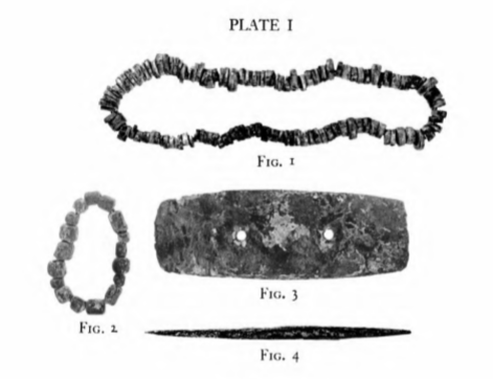 Artifacts found at Burch site, photographs from Cunningham's (1948) report. Artifacts found at Burch site, photographs from Cunningham's (1948) report. After carefully unearthing the skeletons, Burch roughly estimated the height of one of the skeletons by comparing the length of, (presumably) the femur and the tibia on top of each other against his body. Burch reported to The Courier that the femur reached his vest pocket. Based on this exercise, Burch estimated that the two skeletons must be around nine feet tall each.
At some point, the remains were moved into Burch’s house and examined by a Dr. Gamble who thought of himself as “something of an archaeologist.” Dr. Gamble proceeded to announce that the remains were several thousand years old. Beyond the estimated age, the newspaper article gives sparse details of the two skeletons in question. One of them is reported as missing several teeth. In contrast to that, the other is reported as having thirty-two perfect teeth and a larger-than-average jaw. The article goes on to mention that the skeletons were buried with several different types of artifacts, including beads and sandal-sole gorgets. While in Coldwater in the 1940's, Wilbur Cunningham tried to trace the history of the 1906 discovery (the keyword here being "tried"). The doctor who examined the bodies, Dr. Gamble, was dead. The photographer who accompanied Dr. Gamble? He told Cunningham that although he remembered documenting the remains, the photographic plates were destroyed and he didn’t believe that there were any remaining copies. The real kicker is this: after Dr. Gamble examined the skeletons, they were, for the most part, dropped in a corn crib and left there. Sometime between 1906 and when Cunningham visited the Burch farm, the building burned down. Of the skeletons dug up from Burch’s mound, Cunningham was able to get one of the skulls examined. The skull in question was recorded as missing its lower jaw. It's unknown whether or not this was one of the "giant" skulls. Along with having the remaining skull that could be located examined, Cunningham also interviewed Clark Burch about the 1906 discovery. For the most part, his account matches up with the account that he gave in 1906. There is a section in Cunningham’s summary of his interview with Burch that stands out as odd, however: Burch while discussing the skeletons mentioned that one of them happened to have a "double row of teeth" (taken as evidence by today's giantologists). Cunningham dismisses this as a similar thread in many other accounts of giants and theorizes that the double row of teeth may have just been irregular spacing. Although Cunningham’s explanation is a neat one, the 1906 article shows that it isn't correct. Within that account, the author mentions that one of the skulls (the one with the abnormally large jaw) has "32 perfect teeth, not one of which shows a sign of decay." That’s exactly the right number of teeth to make two perfect rows of teeth, or a "double row of teeth" (see this post). It’s very likely that Burch was using an old idiom that Cunningham was unfamiliar with, simply describing that the skeleton had two healthy rows of teeth. Cunningham didn't understand the meaning of idiom, which had fallen out of use by the 1940's, and took "double row of teeth" to mean an irregular placement of teeth. At the end of things, here is what we have in relation to the Burch giant skeletons: a newspaper account, Cunningham’s survey of the site, a skull that may or may not be from one of the reported "giants," and a few artifacts that remained in the mound after the skeletons were removed. What we don’t have: definitive proof of giants in Branch county, Michigan. Unless someone can dig up the photos that were taken in 1906, I don’t believe we will be seeing anything that could definitely show that the skeletons Clark Burch dug up were in fact giants.
13 Comments
Frank Gruner
5/4/2018 10:31:59 am
My parents owned a farm 1/2 mi. E. of Mr. Burch's farm. (some of our farm was adjacent to Burch's)
Bruce Gruner
5/5/2018 07:08:54 am
I clearly remember my father, Clare Gruner, talking about this. The area of Hodunk road being built was just north of where Burch Rd. ends at Hodunk Rd. just north of where the creek runs under the road. It was a sandy bump sticking up out of the low ground. I grew up east of the Burch farm on Burch Rd.
Matthew Clark
6/21/2018 08:15:53 am
Who owns that land now?
Bruce Gruner
6/22/2018 02:03:35 pm
They are owned by Mike Thompson I believe.
Kayla
11/2/2018 11:46:09 am
So there are mounds that could still be dug up? Just curious did your family tell the story of abnormally large bones? Thanks!
Bruce Gruner
11/2/2018 12:51:29 pm
My father Clare who was born on Calkins Rd. In 1904, just talked about them being very tall and they were found during road excavation done on Hodunk Rd..
Bruce Gruner
11/2/2018 12:54:25 pm
There are unexcavated mound like formations on the Mike Thompson property. See my previous posts
CAROLYN GRIEM
12/2/2018 03:08:52 pm
I pass many similar mounds on my drive from NE Macomb County to Caseville. Many are on the farmers' lands and untilled. They are also close to where the Petroglyphs are. I also know of a few graves near our property which I would not want disturbed as there was a hotel on that road. Who knows what is buried there... I would be interested if anyone in Huron County has excavated the mounds that are all around that area.
TODD BENHOWER
2/16/2019 11:41:58 pm
theres some mounds on the fawn river west of nevada mills 2 before orland and 1 after near greenflied mills howe Ind had some and beteween mongo and lagrange stroh at big trukey lake someone dug up giant skeltons I KNOW ALOTABOUT LOCAL HISTORY i WOULD LIKE TO SHARE IF ANYONE WANT TO TALK 260-243-8628
Bobby
5/19/2019 08:20:00 pm
Hi Todd, would like to learn more about the mounds especially the ones in St. Joseph County. Please reach me on Facebook at "Bob's Local History Club". Thanks. 7/4/2022 09:55:00 am
I don't know about the mounds in st Joseph co.only in stueben and Lagrange co. I have found new one near the town Hamilton In.large cone mound that letters from settler's say Indian graveyard
Steven s.
2/11/2023 11:22:40 pm
I'd like to discuss this whole topic with you all to be honest lol
David McDonald
5/19/2019 08:45:32 pm
The November 14, 1906 Courier newspaper article went to some length to describe the find on the Burch farm. I also came across a short piece in the 1879 Branch County History Book on page 221 stating: Leave a Reply. |
AuthorThese blog posts were written by students in Forbidden Archaeology (Fall 2016) ArchivesCategories
All
|
 RSS Feed
