|
A common thread among many ideas about "giants" is that they have a distinct set of physical characteristics in addition to great height. One popular notion is that “giants” have polydactyly (extra digits) and extra teeth (e.g., "double rows of teeth"). Such a unique phenotypic expression suggests that giants were not simply larger than average humans, but beings with a specific genetic profile. Could a genetic disorder explain the perceived association between great height, extra digits, and extra teeth? If we had physical evidence such as bones or teeth, we could potentially use DNA sequencing to directly examine "giant" genetics. The conspicuous scarcity of (read: complete lack of) biological remains of "giants," however, makes such a direct examination impossible. In the absence of actual bones, it is reasonable to ask if there is any known genetic condition that could produce the distinct combination of abnormally large stature, dental abnormalities, and polydactyly. Not only could genetic disorders potentially explain large skeletons with osteological conditions like extra phalanges and teeth, but they could also perhaps account for the high cross-cultural prevalence of giant mythology. There are many archaeological examples demonstrating that individuals who expressed novel phenotypes were treated differently by their cultures; some people with physical peculiarities were even revered or regarded as supernatural. A recent paper in American Antiquity, for example, explored the preferential burial of individuals with polydactyly at Chaco Canyon: polydactyly appears to have occurred at a higher rate in this culture than in most populations due to the special reverence given to individuals with polydactyly and thus the propagation of those genes. Keeping the Chaco Canyon example in mind, it would make sense to assume that individuals who may have expressed a "giant" phenotype of large stature, polydactyly, and extra teeth would have been treated differently, perhaps receiving special burials, and likely being written about with fascination and misunderstanding. I could not find any archaeological accounts of cultures in which giant body size and polydactyly commonly occurred together. And I was unable to identify a genetic condition that produces a combination of abnormal height, polydactyly, and extra teeth. I reviewed a total of 18 genetic conditions that result in abnormally large skeletal size, supernumerary teeth, and polydactyly. I then checked if these three key symptoms overlapped in any disorder. For example, I researched whether or not Marfan’s Syndrome, which results in large stature, may also cause affected individuals to display supernumerary dentition and polydactyly. I summarized my findings in the Venn diagram below and the list at the end of this post. 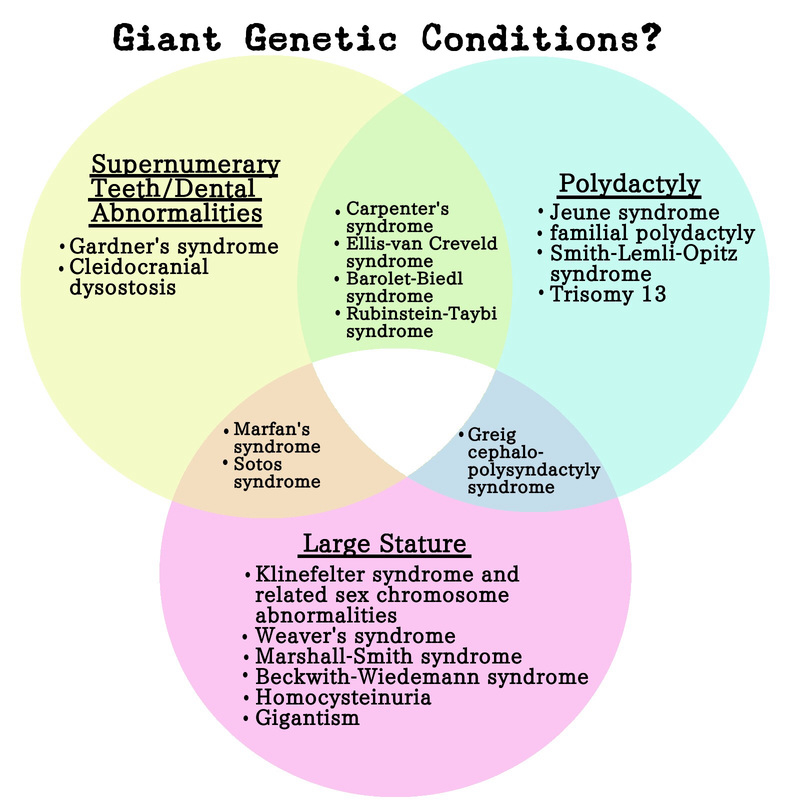 As demonstrated by my Venn diagram, genetic diseases that result in exceptional stature are only accompanied by supernumerary teeth[1] and polydactyly in a few instances: Marfan’s syndrome, Sotos syndrome, and Greig Cephalopolysyndactyly syndrome. No known disorders cause all three symptoms to occur simultaneously [2]. Marfan’s syndrome and Sotos syndrome cause supernumerary teeth only in some cases, but are always associated with excess growth of the skeleton. Greig cephalopolysyndactyly syndrome, however, only results in abnormal bone size in some cases, usually increasing skull size to abnormal proportions, while almost always causing the presence of excess and malformed digits. Some disorders that result in the traits typically assigned to giants cause smaller stature, rather than larger. Cleidocranial dysostosis (which can cause supernumerary teeth) and Jeune syndrome and Rubinstein-Taybi syndrome (which are both associated with polydactyly) usually result in shortened bones and lesser stature. Also, many of the diseases displayed in the Venn diagram result in childhood death, so large numbers of the individuals afflicted with these conditions die before even reaching adult size. Based on modern knowledge of catalogued genetic conditions, it does not seem likely that the potential misunderstanding of skeletons with genetic disorders has been responsible for propagating the idea of giants with extra teeth and digits. If there is no genetic basis for the belief in certain giant characteristics, why are these ideas of giant morphology so popular? As discussed here, the idea that giants had extra teeth likely spawned from a misinterpretation of the phrase “double rows of teeth” due to colloquial changes. Polydactyly has probably been attributed to giants due to the Biblical passage about David and Goliath, stating that Goliath had “six fingers on each hand and six toes on each foot." Ideas about giants with extra teeth and those with extra fingers and toes probably gained traction separately, through different sources, and have been conflated by giant-believers over the years. As pointed out here, there are no known accounts of giant skeletons with both extra teeth and polydactyly. [1] The Venn diagram includes disorders that result not only in supernumerary teeth but also general dental abnormalities. The reason for this inclusion is that individuals with certain disorders express abnormal symptoms in variable ways. Therefore, disorders that cause abnormal dentition may result in supernumerary teeth in patients in some cases of the disorder but not others. [2] The genetic disorders and corresponding symptoms presented in the Venn diagram were collected primarily using information from the Genetics Home Reference website. List of Researched Genetic Conditions
Gardner’s Syndrome
Cleidocranial dysostosis
Carpenter’s Syndrome
Ellis-van Creveld Syndrome
Barolet-Biedl Syndrome
Rubinstein-Taybi Syndrome
Jeune Syndrome
Familial Polydactyly
Smith-Lemil-Opitz Syndrome
Trisomy 13
Marfan’s Syndrome
Sotos Syndrome
Klinefelter Syndrome
Weaver’s Syndrome
Marshall-Smith Syndrome
Homocystinuria
Greig Cephalopolysyndactyly Syndrome
Gigantism
6 Comments
|
AuthorThese blog posts were written by students in Forbidden Archaeology (Fall 2016) ArchivesCategories
All
|
 RSS Feed
