|
In a two-part 2015 article titled "The Establishment Has Already Acknowledged The “Lost Race of Giants,"" Jason Jarrell and Sarah Farmer argue that Adena mounds preserve evidence of a "Unique Physical Type" of giant human that inhabited the prehistoric eastern woodlands: "One of the most controversial subjects regarding the ancient prehistoric cultures of North America concerns what we refer to as the Unique Physical Types (UPT). For the purposes of what follows, these UPT are often gigantic humanoid skeletons with high-vaulted crania, occasional extra or pathological dentitions (including several reports of double or triple rows of teeth), and are usually discovered in the burial mounds and associated graveyards of the Adena-Hopewell, Archaic Cultures, and Southeastern Ceremonial Complex." Jarrell and Farmer argue that these UPT existed as "an elite race within Late Archaic/Early Woodland societies who were often buried in the mounds," stating that "dental and bone anomalies have been used to establish a genetic connection between individuals at mound sites. 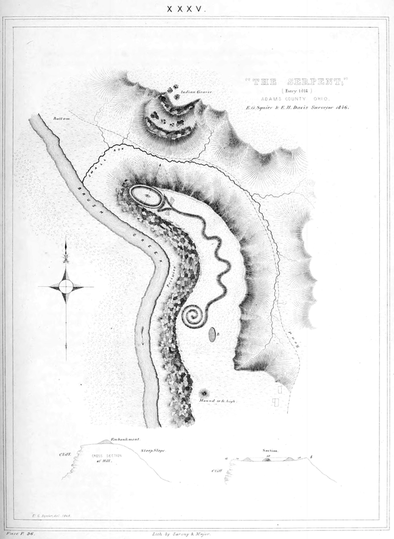 Serpent Mound, now thought to be an Adena construction, as shown in "Ancient Monuments of the Mississippi Valley" (1848). Serpent Mound, now thought to be an Adena construction, as shown in "Ancient Monuments of the Mississippi Valley" (1848). Some components of Jarrell and Farmer's argument are plausible: Early Woodland people often did bury their elite in earthen mounds, for example, along with other material objects that might be important to them in the afterlife. The accounts of skeletons chosen by Jarrell and Farmer, however, do not support their contention that there is a "Unique Physical Type" with a genetic basis. They provide not a single example of a skeleton that has all three of these "unique" features (gigantic stature, high-vaulted cranium, and extra/pathological dentition) that define their "UPT," and at least two of their "genetic" features (high-vaulted crania and extra/pathological dentition) probably have little to do with genetics. Gigantic Stature There are several accounts from the 19th and 20th centuries that report skeletons of relatively tall stature in Adena mounds. Jarrell and Farmer provide several of these as evidence. The account from a "Professor Holbrooke" is typical: “Judging by the thigh bone he must have been seven feet tall. The skull was much larger than usual, very thick, the forehead unusually receding, the top flattened. The jaws were extremely strong, full of large, perfect teeth.” This account is an example of what was probably a common practice: estimating the height of an individual based on a single bone (the femur), perhaps using the common "height = 4x femur length" formula that would tend to overestimate height. Examples of the evidence for "gigantic skeletons" is shown in the following table: 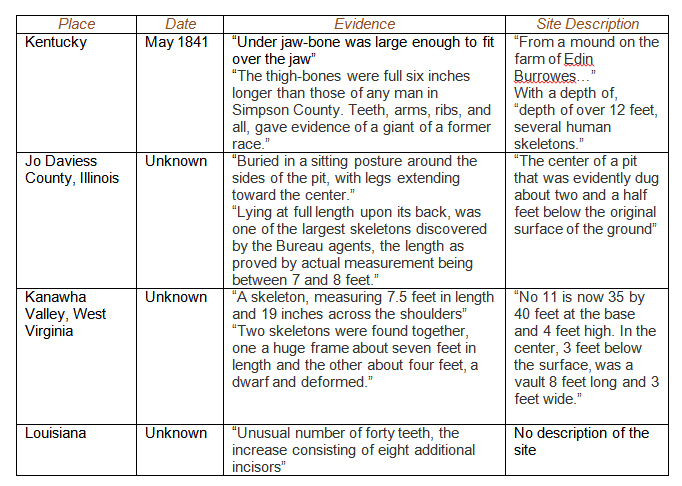 High-Vaulted Crania In The Adena People, William Webb and Charles Snow remarked that “Approximately 89% of the adult males, 92% of the adult females are brachycephalic.” A brachycephalic skull is a skull with a cephalic index greater than 90%. The cephalic index indicates, “a number expressing the ratio of the maximum breadth of a skull to its maximum length.” The amount and degree of brachycephaly in the prehistoric Ohio River Valley was almost certainly related to artificial cranial deformation, a cultural practice that has occurred in many different parts of the world. Artificial cranial deformation or cradle boarding has been described as an intentional distortion of a baby’s skull by administering force. Historically, one would start the process directly after birth up until the infant was about 6 months old. The skull would then be perceived as flattened, elongated, or rounded. One idea is that Adena people used artificial cranial deformation to indicate social status. Due to the nature of the process, only the elite were subjected to skull deformation because it was seen as aesthetically pleasing and with a greater capacity of intelligence. Extra/Pathological Dentition The third component of Jarrell and Farmers UPT is extra/pathological dentition. Other than the skeleton from Louisiana with extra incisors and some accounts of supernumerary teeth, they don’t provide any real evidence of these features. The description of "perfect teeth" by Holbrooke contradicts the idea that the UPT is characterized by abnormal dentition. Andy White has written extensively about the "double rows of teeth" phenomenon, which appears to be related to a set of linguistic idioms rather than a real biological peculiarity In summary, Jarrell and Farmer provide little evidence for the existence of a gigantic "Unique Physical Type" among the prehistoric peoples of the eastern woodlands. They describe some burials that were reported as taller than average, but do not make a convincing case that those burials are of a different "race" or "type." The tall burials, if they really were tall, may have been a social elite but were certainly not of a "Unique Physical Type."
In summary, Jarrell and Farmer provide little evidence for the existence of a gigantic "Unique Physical Type" among the prehistoric peoples of the eastern woodlands. They describe some burials that were reported as taller than average, but do not make a convincing case that those burials are of a different "race" or "type." The tall burials, if they really were tall, may have been a social elite but were certainly not of a "Unique Physical Type." The concept of a unique "type" of people building the earthen mound of eastern North America harkens back to 19th century ideas associated with the Mound Builder Myth (i.e., that the mounds were not built by Native Americans). However wrong, the idea lives on.
15 Comments
Brad Lepper
10/8/2016 09:07:43 am
Regarding the Serpent Mound "giant," the Peabody Museum shared with me the measurements for the length of the femora (both left and right) of the purported “giant” excavated from the base of the large conical mound at the Serpent. Based on the most current and accurate equation for determining stature from the length of the femur, this individual was 5’ 6” tall. He was, therefore, one of the tallest people documented for the Early Woodland period, but hardly a giant by anyone’s definition.
Andy White
10/8/2016 09:10:32 am
Thanks Brad. Is that the "7' giant" shown in the postcard? Can you share the femur measurements?
Brad Lepper
10/8/2016 10:30:28 am
The "giant" in the postcard that I just found online appears to have both femora broken, so this is obviously not the individual who the Peabody curator measured for me. What I had heard was that the individual who was buried at the base of the large conical burial mound at the site was a giant, so it was this person's femora for which I requested measurements. Looking at the caption of the postcard, I see no reason for thinking it represents a giant. There is nothing in the image that can be used for a reliable scale and the caption doesn't even specify where it was located at the site. Who took this photograph and who wrote the caption? Once I'm back in my office I'll track down the measurements for you.
E.P. Grondine
10/10/2016 10:57:42 am
Hi Brad -
Geoffrey Sea
10/12/2016 08:14:34 pm
Based on the Peabody Museum photo of that I skeleton, I estimated the height of that individual as 5'6" based on femur ratio, so thanks for the confirmation. You should know that as recently as one month ago, individuals with the Friends of Serpent Mound group are still displaying that photo publicly and claiming that "scientifically" they have determined that individual to have been about 8 feet tall. The data on this should be displayed prominently at the Serpent Mound museum in order to debunk this crap.
Geoffrey Sea
10/12/2016 08:28:22 pm
To clarify -- that is the photo of the skeleton with the broken leg bones that they are claiming was a giant, so two different skeletons are at issue. Measurements of the skeleton with the broken-off legs are necessary to evaluate the giant claims.
E.P. Grondine
11/18/2016 06:59:25 am
Hi Geoffrey -
JA Sterling
10/10/2016 01:32:19 pm
Nicely done within the limited framework of determination on the validity of the 3-part evidence presented by Jason Jarrell and Sarah Farmer in regards to the unique body type term. Straight and to the point. Thank you for sharing your work and I wish you the best in your studies ...
E.P. Grondine
10/12/2016 08:15:19 am
One problem - we have eye witness accounts of one very tall people at the time of European contact:
Geoffrey Sea
10/12/2016 08:47:51 pm
It is ironic that the first popular scientific theory after the naming of the Adena was that they had been "Mayan colonists" -- the Maya being among the shortest groups of Native Americans with an average male height of about 5'2".
E.P. Grondine
10/13/2016 07:48:20 am
Hi Geoffrey -
E.P. Grondine
10/13/2016 08:05:20 am
I feel a need to pass on in this discussion an observation made long ago by Percy Bullchild, that "whites" generally assert that Native Peoples were/are stupid, and thus too stupid to have built the remains found in the Americas.
Interesting stuff. At this point, I think any confirmation that there was a priestly or elite lineage of shamans among Adena or Hopewell, who sometimes had really tall chieftains and leaders, would be fascinating. I think it'd be a satisfactory explanation or at least a potential context to some of the Giant skeleton newspaper stories printed in the 1850-1920's heydey, if some indeed were pushing 7 feet or so.
E.P. Grondine
11/18/2016 07:09:55 am
Thanks for bringing up the Dinka and Watusi in Africa.
Yeah, I think it's possible segements of the population, certain tribes (or nations if you will) were tall people. Webb and Snow in Dover Mound, record that of the 60 bodies, over 40 were extended skeletons, bodies of 8 men averaged 5 feet 10-1/2, and several men were 5 feet 6 inches from crown to heal, and 4 men were over 72 inches long, one of them approx. 84 inches. The femur of one man, height not given was recorded at 48.8 cm, which is 19-1/4 inches. And the average of femurs from 4 other men, were 18-1/4 inches, 46.3 cm - Height estimates using Trotter and Glesser, and other regression formulae yielded stature estimates of 5 ft 6 to 5 ft 7 for the average of Adena males at Dover, and 5 ft 2 for females. But the height estimates were only taken from the the most complete long bones of only 4 men and 1 woman, versus the 40 odd extended in-situ skeletons--so under representative of the whole group. I believe the In-situ lengths are approximately equivalent to standing, living height, provided the skeletons aren't too fragmentory. If we casually just subtract 3 or 4 inches across the board for all the skeletons insitu lengths, to force the 5'10 men to fit 5'7" regression estimates off a minority of the skeletons, then we also have to shave several inches off the number of 5 feet 6 inch insitu lengths of men's skeletons Webb and Snow record, and 5 ft women - making the range of Adena 5'3 to 6 ft 9 for males, and 4 ft 9 to 5 ft 3 for females. Leave a Reply. |
AuthorThese blog posts were written by students in Forbidden Archaeology (Fall 2016) ArchivesCategories
All
|
 RSS Feed
